Showing posts with label simplicity. Show all posts

Tuesday, December 31, 2019

Living Simply without Amazon

This would have been a good post for before the holiday,s but it is very much on my mind this month since so many of my progressive friends have with apology sent me gifts thru Amazon.  Thus I would like to lay out here some of my reasons that living without Amazon is to me a social justice issue.

In general I think huge multinational corporations function without souls in ways that are bad for the environment and bad for labor and bad for the human community.  So in general I try to encourage f/Friends to as much as possible steer way from chains and spend money at mom/pop locally owned stores which much more keeps money in your own local economy.

In the case of this particular corporation however we must look at both the carbon foot print of it and how it is effecting economies throughout the US (and world).   In the old model products were produced and were then shipped to distribution hubs and then to stores around the country with a concentration in department stores or malls that had the additional money for bigger stock selection than smaller stores.  Then  consumers took them home.    This path of miles traveled from producer to distribution hub to store to home might look like: 300 miles + 100 miles + 10 miles = 410 miles.  Now it looks like 500 + anywhere from 10 to another 500.   (They have 20 disruption centers around the country.  If an item is not in the one nearest you it will ship from where they do have it.)  So transport is a bigger carbon foot print but so is packaging since now huge numbers of items are being packaged independently rather than all in their original package and going in one bag at the store with you.  Quite often items you ordered at the same time will go in separate boxes and be delivered on separate days by the same UPS or Fed Ex driver.  This is a terrible carbon footprint.
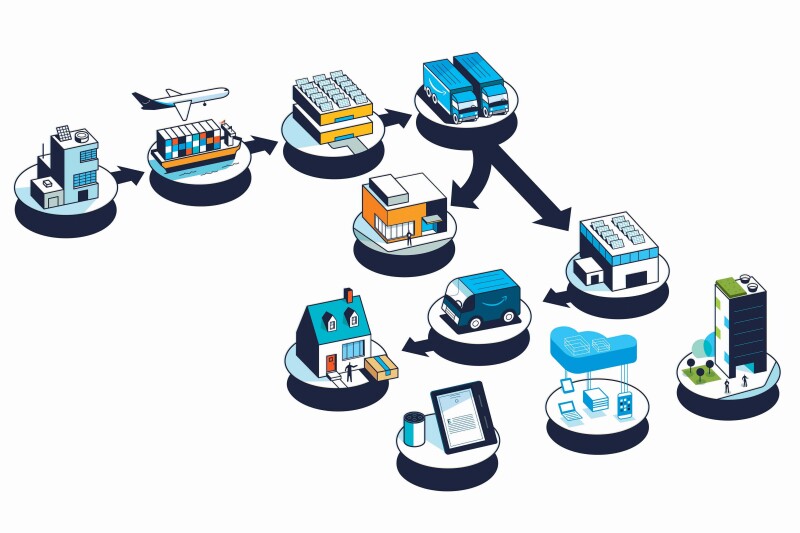
Carbon footprint

Then there is the effect on the economy.  Because small stores and even department stores cannot compete with the allure of people having every choice manufactured they are consistently losing business to Amazon.  As a result more and more small business are losing business and going out of business.  Even large chains like Toys R us, Sears, etc are going under.  The loss of brick and morter stores is the loss of employment in lots of moderately sized communities around the country.  And with it the loss of more money in the local economy.  It drives even more urban growth to the 20 cities that have Amazon hubs.

CBS revealed the following:
The rush toward ever-faster shipping is creating the need for more truck trips, undoing the ecological benefits of shopping online.Amazon's package deliveries in 2017 alone emitted about 19 million metric tons of carbon, according to one estimate. "That's just under five coal power plants," one expert said.

Not long ago online shopping was better for the climate than the in-person kind because it benefited from economies of scale. A shopper who's driving from store to store in a car can create a lot of emissions, Anne Goodchild,  "Delivery services can be better -- they can put lots of stuff in one vehicle, do one delivery route and hit lots of homes," she said.

But while that model prevailed in the early days of online shopping, today it's reversed, with very small and quick deliveries -- what she calls "paid butler services" -- growing the fastest. Data show that package deliveries are indeed speeding up. In the last two years, the average time for an item to get from "click" to a customer's door dropped from 5.2 days to 4.3.

Amazon's decision to make one-day shipping the default for its Prime members is likely to increase its emissions ever further. In 2017, Amazon's deliveries alone emitted about 19 million metric tons of carbon, according to an estimate from 350 Seattle, a group that works to combat climate heating. "That's just under five coal power plants," said Rebecca Deutsch of 350 Seattle.That same year, FedEx was responsible for 14 million tons, and UPS for 13 million, according to CDP, a nonprofit that helps companies track emissions data.


The collapse of these other levels of scale builds a monopoly.  We know from history the more an organization holds a monopoly the more we are at their mercy with prices.  Don't count on this government to pursue monopoly busting.  It is up to you to not give them monopoly power.

Some of us, in a world where clothes are made for "standard bodies" which few of us have, still need to go into a store and try on clothes to see if they fit.  Not everyone has the economic means to order all the many many things they want to try on and time to repackage and take back to be mailed back and get the credit.   Everyday people still need stores.  Also in the long run of fixing climate change we need not only stores in our community with their smaller carbon footprint but we need much more regional self sufficiency over all were we make and use things locally.  The trend of Amazon takes us in the wrong direction.

However, living at "ground zero" as it were for Amazon (Seattle) I have an even more up close and critical view of this particular corporation.  Some cities that were bidding for Amazon's next distribution center could not understand why Seattle was not trying to keep all Amazon's business in Seattle.  Well if you lived here you would understand.   "The death of Seattle" as reported recently in a documentary is largely attributable to Amazon.  The huge growth has resulted in escalating cost of office and warehouse space, increased population and with it huge traffic snarls and skyrocketing housing prices and increased overall cost of living.   The pressure on housing resulted in a huge development bout where any small or old property was likely to be torn down and much bigger and taller housing replaced it (also resulting in huge tree loss), hugely driving up the prices.   Small businesses were torn down to build 7 story condo or office buildings with one strip mall type antiseptic storefront at the bottom.  Seattle was re-gentrified loosing all of its character and soul.  Locals mourn the loss of the city they once new.  I moved because I could not stand the constant daily loss.

After the city council tried to impose a tax that would have been heavily applied to Amazon, they ran a misinformation initiative campaign which they used paid signature gathers for and won so that the tax did not go into effect.  Then they spent 2.5 million on the local Seattle election to try to buy the Seattle City Government.  Fortunately they failed.   But this is why I find them extremely objectionable.

So I would again ask you - is this the world you want to support?  You are voting with your dollars.


What are your alternatives?  Fun fact - anything you buy locally and take to the post office will likely cost less than the "standard" shipping for any online ordering (except where free) since it is having to base it on an average size package rather than the actual size and weight of your package.  For those of you so pleased with your "free shipping from Amazon" please note there is no such thing as a free lunch.  Shipping costs are folded back into overall prices and the environment is certainly paying the price of all this shipping everywhere.

For Books - First choice - why not support your local book store? 
If there is not one, support Barnes and Noble while it still stands (on shakey ground because of Amazon).  Can get any book and ship to your relative across the country.
Or better yet use better world books - an online alternative to Amazon which means it also has a big inventory which has donated 8.6 million dollars worth of unused books to global literacy groups.
https://www.betterworldbooks.com/

Clothing: First choice - go to local clothing stores
If sending to a family member across the country again use a chain that is still in existence and does shipping and is not Amazon.

Electronic items:   First choice buy at a local store and ship yourself.
Chains like Best buy, or Penny's or Macy's do ship.

Cool artsey stuff:  support real artists and crafters across the country to have a further reach.  Use etsy.com where you can find any kind of custom made item.

Some of you may find this a confusing message: Isn't she just really suggesting one shipper verse another?   Well my first choice really is that we all support the local businesses in our communities - that is still by far the better carbon foot print and better for the economy.   Along with that we move away from giving stuff (which also uses resources and has transport foot print behind it, and is part of a lifestyle that will need to become our former lifestyle) and give experiences and services instead.  So for example you give a friend tickets to a massage, or pay the local kid to shovel their drive, or give a ticket to a play (perhaps with you- best of all!)  When you start to think this way there are lots of possibilities.

But I realize that everyone we wish to give a gift to does not live right where we do.   Which is why I remind you that there are at least other chains than Amazon to buy from.   But if you get creative there are ways to give experiences even across the country.   A few years ago I gave my adoptive mom a dinner out by calling her favorite local mom and pop restaurant and they do have gift certificates which I paid for over the phone with my card.  They mailed it.   My in-laws live in the town of my daughter and partner and bought them a couple's message.   But I could have called and paid over the phone for that as well. The same can be done for local theater, etc.   So think outside of the box!  Support the world you want.


Saturday, March 31, 2018

The Seeds of War, Suffering and Climate Change

Last month I wrote a post: Who is Wealthy?  Designed to help US citizens understand how much income they have relative to other people from the US and how even a median income in the US makes us part of the 1% of the world.  This month I would like to look at the labor practices in other parts of the world that allow us to buy cheap items from elsewhere in ways that enrich our lives while keeping in poverty and suffering people around the globe.

One of the most famous John Woolman quotes is: "May we look upon our treasure, the furniture of our houses, and our garments, and try to discover whether the seeds of war have nourishment in these our possessions."  At the time Woolman wrote, he was of course thinking both of slavery and also of wars that were fought over resources.   In modern day translation I would add: whether the seeds of war, suffering and climate change have nourishment in these our possessions.

For example many people are aware of "conflict minerals": tin, tungsten, tantalum (3ts) and gold which are mined in African countries, and particularly the Congo, controlled by guerrilla groups using the money to fund a civil war which has killed over 5 million people since 1998.  Amnesty International has also documented the use of child laborers, as young as age 7, being made to work in these mines. These materials are used to make smart phones and many computer chips.   Only 16% of our phones are even recycled -so these built to be obsolete items contain materials we throw away that others have literally died for.  Efforts by a company named Fairphone to build a completely non-conflict sourced phone have yet to be successful

Gold of course is also used in jewelry as are diamonds: also known as "blood diamonds" in some circles because of the violence associated with them.   African miners make a dollar a day, again often use child labor and work in war zones.  Violence is often directed against the workers and the environmental practices leave areas around the mine devastated. 2

The Enough Project attempts to provide us some rankings for these companies so we can reduce our complicity.   For example Apple has done a pretty good job of reducing its conflict minerals followed by Google, HP, Microsoft, and trailing at the bottom Samsung and then Toshiba.   For Jewelers the department stores that have the most blood on their jewelry are not surprisingly Walmart and Sears being worst, Helzberg and Costco close to the bottom and with Signet and then Tiffany's doing the best.3

And then there is Chocolate.   For years the media has been documenting that African (Ivory Coast and Ghana producing 60% of the worlds cocoa)  has child labor and even child slavery being used to pick chocolate.4  Many of these same issues surround the production of coffee, teas, bananas and coffee.  Fortunately there is a Fair Trade designation for these products that attempts (some better than others) to document that fair labor practices, as well as environmental standards, were used in the production.5

Cotton of course is in our clothes.  If not organic it has been produced with chemicals very hard on the earth. But really for all our clothes when you look at the label that says where it has been made, almost inevitably you will see some of the poorest countries in the world where there are not protective labor laws and where workers work long hours for little pay.  Sweat shops have simply moved abroad.   This is why inexpensive clothing can be found for prices you could not match by just buying the fabric and making it yourself in this country.

Before I completely leave this list of horrors there is also the rape of the earth categories.  If you were to see pictures of areas of the amazon that have been clear cut to: provide cheap teak wood, land for raising cheap beef for $1 fast food hamburgers, or for palm oil which is in most processed foods and beauty products in the US you would be horrified by the pictures.  Yet we innocently buy these products with no awareness of the havoc that was wrecked to bring them to us.  Deforestation is one the huge contributors to climate change.  (10 to 15% of the Greenhouse gases)

So yikes: here are the seeds of war, suffering and climate change in our cellphones, our computers, our electronics, our jewelry, our food, our clothing, our cosmetics, and our furniture.  I really was not trying to depress the hell out of you!   I know most of my f/Friends would not stand in front of a child factory or a clear cut forest and buy the products coming out of there.  We in fact have happily believed that child labor, slavery and environmental destruction were things that were outlawed a 100 to 40 years ago.   Well they were in the US.  But one of the results of globalization is that it hard to find a product that in solely and completely produced in the US.  Most ingredients or components at least come from other countries where they were extracted with cheap labor and in environmentally destructive ways and then the finished products or the components for assembly were sent to another country or the US for final assembly.  We are inexplicably bound to suffering around the globe that is conveniently kept out of our sight.  Perhaps because we would not participate in it if we could see it.

So as painful as this is the first step in changing this is bringing its reality into our awareness.  Looking at our possessions and understanding in fact where they do come from, seeing the humans behind our possessions. Unfortunately, in the globalized economy it is not possible to live in an industrial country and be able to separate yourself from this chain of suffering.  So there is not a way to achieve some moral purity - there is only the possibility to start pushing back and trying to create more justice and fairness one bit at a time.

What are some of the solutions:
1) Buy less - you will create less suffering - to quote an old saying: "Live simply so others may simply live".
2) Recycle and reuse and repair - as 70's as that sounds when we reuse materials more mining does not go on.   When we reuse items more new production does not go on.
3) Learn about fair trade certifications and buy products that bare fair trade labels.  Yes it will cost more - I think it is worth it to not support child labor, slavery and people working for $1 a day.  I will have to buy less and save for some things - and probablt represents the true costs and a more fair balance of resources in the world anyway.
4) Look at the Enough Project and try to buy on the fairer end of the spectrum - create consumer pressure for products that are produced with fair labor and environmental standards.  Buy a Fairphone the next time you replace your cellphone.
5) Buy less processed foods - they are healthier for you anyway but they will not contain palm oil or foods produced with cheap labor in another country.
6) Consider giving services and not things as gifts to others.
7) When possible buy items made by artisans in your own community.  (Examples: hand made jewelry, clothing, items made by wood workers, bakers, carpenters, etc in your own community.)


1 http://www.newstalk.com/Can-you-buy-a-conflict-free-phone-minerals-intel-fairphone-apple
2.https://www.brilliantearth.com/conflict-diamond-facts/
3. https://enoughproject.org/reports/demand-the-supply
4. http://fortune.com/big-chocolate-child-labor/
5. https://www.fairtradewinds.net/guide-fair-trade-labels/


Tuesday, January 9, 2018

Why Quakers should be Vegetarians

This article appeared this month in FJ.   Here is the slightly longer unedited version.

Being a Vegetarian is a Climate Issue                                           By Lynn Fitz-Hugh
I would like to make the case for Quakers becoming vegetarian.  Quakers at one point wore black and white clothing so as not to create a market for dyed clothing because the dying process was so carcinogenic that those working in the industry died young.  Quakers also, over a process of many years came to unity on the practice of owning slaves as inhumane, unjust, and inequitable. Our testimony of simplicity has always called us to own less as a way of not being driven by material attachments or over consumption of our earth’s resources..  John Woolman called us to look to our possessions and removed the seeds of war (and I would add suffering.)  All of these ideas: caring for our ourselves, our fellow human beings, and the earth, lead me to conclude that the modern day application would be for Friends to become vegetarian. 
.
I first became a Vegetarian while attending Earlham and I have been a vegetarian, of some stripe now for 4 decades.   I became vegetarian not for health or spiritual reasons or the issue of animal welfare.  (Although after reading Charlotte’s web in childhood I never again ate pork)  I became vegetarian for political reasons. I learned at Earlham that we could end world hunger if we stopped using food to feed cattle consumed by people.

I will briefly describe my journey with vegetarianism to illustrate the point that there are many ways to flexibly hold a witness about the effects of meat production on our environment, animals and our planet.  I grew up in a meat and potatoes kind of family where every meal was meat, carbs and over-boiled veggies. I therefore could not even imagine how someone could or would eat vegetarian.  The first time I had a week of delicious vegetarian meals when I was 21 I was instantly converted.  I knew then that it was possible to eat well without meat.  Nine years later I wound up in a situation where I had to travel a stretch of road dotted with one fast food restaurant after another during dinner hour and then enter a facility for three hours that had no food! The only thing I could find to eat was bean burritos at Taco Time. That was okay for a while but after three months of bean burritos three times a week I thought I would barf if I saw another one!  I reluctantly added fish back into my diet.

For the next 15 years, I only ate meat outside of my house and then infrequently . In order to welcome my meat eating step-son into our house I began to cook chicken and fish at home. My husband at the time, who had been 100% vegetarian for nine years, was amused that I describe myself as vegetarian.  I told him that so far, he had still eaten vastly more meat in his life than I and that would be true for years. After we divorced I stopped eating meat again.   Then I developed some health issues that the doctor said was from not eating enough animal protein.  Currently I eat fish and eggs each once a week which seems to be enough to maintain good health. Apparently, sometimes what we wind up eating is a series of events created by the landscape we travel.  

In my early vegetarian years, I learned quickly that simply mentioning that I was vegetarian brought a strange guilty/defensive reaction from others.  Without my saying anything other than “I don’t eat meat”, people would start offering explanations and justifications for eating meat.  I learned not to make a big deal about my choices because I got tired of listening to people’s guilt. I had not become vegetarian to assume a position of moral superiority over others.  I mention this because some of you as you read this may notice feelings of guilt or defensiveness.  I ask you to try to wrestle with those feelings.  I suspect that Friends who were first asked to give up owning slaves also wrestled with guilt and defensiveness.  I think that each of us will have to do the best we can with the moral issues present at this point in history that involve meat production and consumption.  

As my bumpy path demonstrates I have no morally superior position to speak from.  I am not trying to tell the reader how to eat.  I am however  asking you to exam the moral issues with meat consumption in the age of climate change.  I also think that this is not a black and white no meat no dairy or everything.  Some people choose to be vegan, some vegetarian, some eat no red meat, some are pescatarian eating only fish, and some just eat less meat than they used to.  Change is not easy, but if we hold this loosely we can explore and begin to shift.

Climate Change

The first reason that I would call Friends to vegetarianism is climate change.  Friends overall are well aware of and very concerned about the threat of climate change. Friends have earlier written to FJ about why climate change touches on every one of our testimonies.  Early in my climate activism I started making a comprehensive list of what people could do to lower their carbon footprint.  What blew me away was discovering that one of the biggest reductions people could make was simply cutting out eating meat!   The fertilizer used to create animal feed, the transport of the feed, the amount of feed to produce a comparable amount of animal protein, and the transport of the animal are all very energy intensive activities.  Eating lower on the food chain and eating foods grown organically produces far less carbon.  

There’s yet another drawback to eating animals such as cows and sheep.   Their manure, burping and flatulence deposits large amounts of methane into the atmosphere, and methane is 20 times more effective at trapping heat in the atmosphere than carbon.  I know that sounds like a joke, but it is true.

I have seen various charts showing how much carbon per day/per year a person would save if they didn’t eat meat.  The data doesn’t agree exactly, but they all show HUGE savings.  By one estimation if you cut out eating meat one day a week for a year, you save 700 pounds of carbon, cut it out two days a week  you save 1400 pounds of carbon a year and cut out all meat and you save a whopping 4,900 pounds of carbon a year. By point of comparison switching out one 60-watt bulb saves 100 pounds a year.  

A more conservative chart showed the savings from giving up all meat to be equivalent to giving up driving a Prius. (Some of this depends upon how much meat you were eating to begin with.)  The UN list meat production as 18% of worldwide greenhouse gas (GHG) production.   What would happen to climate change if we all cut out that 18% of GHS emissions in the next year? This is the point at which I went back to not eating any meat.  The newly released book Drawdown by Paul Hawken’s lists 200 ways for humans to reduce or sequester carbon.  The fourth solution is eating a plant based (non-meat) diet.

Again, if one holds flexibly the goal of eating less meat to achieve more social justice, it is helpful to know the following.  The production of lamb is by far the highest carbon footprint, two times that of beef which is also terrible.   After beef, cheese has a little less than half the footprint of beef (but still high because of how cows are raised in the US), then comes pork, salmon, turkey, tuna…with tuna being half the footprint of pork, and eggs just a bit less than tuna.    Yogurt or tofu has one third the footprint of tuna.  Inexplicably cow milk is lower than even vegetables. (See www.ewg.org       For chart) 

A vegetarian who did not eat cheese, but did eat eggs, yogurt, tofu and milk could get enough protein and produce relatively low GHG emissions. Forty percent of all energy used for industrial agriculture is for fertilizers and pesticides.  Thus organic food systems use 30 to 50% less energy and the soil sequesters about 28% more carbon than industrial-farmed soil.

Clearly being vegan would have the best carbon footprint, but there are significant health issues surrounding eating vegan.  (Hats off to those of you who put in the effort to do it safely.)  There are also vegans who feel that it is indeed perfectly safe and there are conflicting studies about this.  Like all the choices mentioned here eating vegan may work for some though not all.  Each of us needs to find our right choice.   

Peace Testimony

Not killing animals speaks to our testimony of non-violence. Even if you are comfortable with the idea that in the cycle of life some animals eat other animals, I would suggest that if you take even a cursory look at Confined Animal Feeding Operations (CAFOs), you would be horrified.  The animals are raised and killed in inhumane, crowded and violent ways.   This, at a minimum, is reason to look to pasture raised animals.


Climate change is creating drought and resulting food shortages.  The argument has been made, I feel convincingly, that the war in Syria really began over food shortages.   So the issue of using food to feed production livestock rather than export it to other countries so more people can eat is a peace issue.

Social Justice, Equality and Simplicity

As explained above meat is an energy intensive way of producing protein. Seventy nine percent of farmland is for livestock feed and pastures.  Rich countries have higher levels of meat consumption (and resultingly higher obesity levels).  We could feed 2.9 billion more people if meat were not produced.  One acre of grain produces five times more protein than one acre used to produce meat, and feeds 25 people as opposed to one carnivore.  Meat production is also a much more water intensive way to produce food, and as water becomes more scarce it will also be increasingly more of a resource issue.  Both equity and simplicity testimonies always have been about not living in ways that deprive others of their quality of life.  The idea of “live simply, so others can simply live” is embodied here.

Earth Stewardship

Quite aside from all of the climate change issues mentioned above, CAFO’s (where most meat in the US is produced) are one the greatest contributors to the pollution of local creeks, ponds, rivers and aquifers due to the runoff from animal waste into these water sources.  The way mass crops are produced (most of which in the US are for animal feed) under agribusiness strip the soil of nutrients and do not sequester carbon like organic farming methods do.


So Friends I invite you to take up the challenge of reducing or eliminating your meat consumption!  I would like to see that for our Quarterly, Yearly and annual gatherings like FGC that we try working with our food providers to provide only vegetarian meals.   This would be a great way for Friends to experience delicious and healthy eating, and to support those who are working on such changes.  I invite you to this witness for peace, equality, stewardship and justice.

Wednesday, September 30, 2015

Downsizing- and Quaker Simplicity

I have an empty nest.  My only child left for college.   My father taught me the way to retire is to own your home outright by the time you retire so rhat your income can pay for everything else.   I came late to that project (45) and took out a 30 year mortgage.   Was pretty clear I did not want to work till 75.   So with downsizing and buying a smaller place this means carving that mortgage down to something closer to when I want to retire.

Query 1) What do I owe money on?  Is it worth the time I will spend working for it?

I had had a too big living room.  I had a den and my daughter's room.   Seemed like combining them would account for 300 extra square feet.  In my mind all the furniture fit in this new configuration of space.   Except I forgot to notice that the good closets in this space where stilll in smaller space  - in otherwords less storage space.   So here comes moving day and in the days following as I go to unpack I realize I have never moved to smaller space.   Everything is not going to fit.  I have to actually let go of things!  I see my things with new eyes:

Query 2)  When is the last time I used this item?  Will I really use it again?

The easy items are the ones you can says years and no too.   I get to notice things (that I have studied in books) like how in a low income mindset you keep stuff because you don't know if you will need it again, but you know you may well not have money for it if you do need to get it again.   I have more money now than when raising a child.  

Query 3) Is it ok to let go of something I'm not using by telling myself I can buy it again if I need to?  Is it simplicity to have less things?  Or is it simplicity to buy less things over time?

But the worse dilemma is my own sentimentality.   Here is something from my (long) dead mother. Here is something from my daughter's baby years.  Here is something from my happy College days.
Can I bear to let things go?  The things are not the emotions, but they do evoke the emotions.

Query 4) Is there an appropriate role for sentiment and memory in simplicity?

Worse yet were the gifts.   So many things people gave me.  Some that I love and use and those are straightforward.  But what about the unwanted gifts?  What about the things dutifully held because they represent the love of the person who gave it?  My daughter has thrown away things in leaving for college that she currently does not find useful, but that I worked hard to provide for her.

Query 5)  How to honor simplicity and the loving intentions of those who gift us?

As my friends helped me carry the hanging cloths from my closet to the car, I started to feel guilty.  Really there are so many.  The first world guilt kicked in...there are people in other countries that have two changes of clothing, or have only tattered clothing.   Here I am with a 6 or 7 foot pool of clothing.   That's it, I thought, I'm going to pair this down.   I thought it would be easy that I would simply get rid of things I had not worn in a long time.   But I discovered as I looked, that I will wear many things once a year, just because I feel that way that day.  I decided well I will just make a reasonable rule:  I will only have X number of button shirts, and Y number of pants.   But then the season thing starts: well I have to have warm and cold weather things, and then the inbetween.  So how many is a reasonable number to have?   A weeks worth of shirts?  But what about dresses then? While this all sounds like I'm a clothes hound the truth is I wear things lightly rarely ever wearing things out.  I still have t-shirts in good condition from 35 years ago!  So I actually probably buy far less clothing than many Americans because I keep it and just add one or two items a year.  I achieve variety not by getting rid of getting new stuff, but by rotating through my decades of clothing.  (Ridiculed by my sister for never being "in fashion".)  

Query 6)  What is enough?  How many is enough?

I have moved a lot in my life.  It has kept me honest.  Every move I got rid of stuff I had not used, that I did not want to keep carrying around.  Compared to most Americans my age I am already traveling light.   And yet compared to most people in the world I am indeed wealth and the owner of much.  I have tried to care for my things, to use them lightly, to not cast things aside because they are no longer new or shiney, to keep them working as long as possible.  This to me is what it means to be a good steward of resources.   But there is a place to say "no this does not go to Good Will; it goes in the trash" - to recognize the end of the useful life of any object.  My depression era parents often kept things to fix them and make them useable again.  But really they just sat around.

Query 7)  Do I know when to let go of something?

The final query is one I got years ago from a book and I have kept it in my mind and it has served me well.  It has spared me from being owned by my possessions, helped me notice the real cost in time and energy of owning some kinds of things.

Query 8)  Do I own my possessions or do they own me?

As you can see simplicity is not simple!


Sunday, April 26, 2015

Quaker Parenting

This article appeared in Friends Journal in the April 2015 issue.
By: Lynn Fitz-Hugh & Sara Alice Grendon

My daughter, age 16, is a dyed-in-the-wool Quaker.  Other Quaker parents are often very curious how I pulled this off.  To me one of the most significant things is that from her birth, I felt I was steward of a spiritual being, a soul sent into my care and nurture.
I noticed early on her own expressions of spirituality, and unlike non-religious parents who might ignore or even discourage these expressions, I encouraged and nurtured them. My daughter had a great love of nature and expressed a sense of awe that tied what she encountered to a sense of majesty and the mystical.  I affirmed this.  I was influenced by the writings of Barry and Joyce Visnell who say that our image of An All Powerful and hopefully Loving God is shaped by our early experience of our own parents as all powerful.  This makes much more important how we as parents use power and model just, fair, compassionate and truthful behavior.
I am a leader among West Coast high school Friends, and soon to be part of a lovely team of powerful young Quakers, clerking FGC’s high school program. You don’t get this way by accident. There are choices my mother made as a Quaker parent which led to my growing into my Quaker-ness, and I suspect if one asked my weighty Young f/Friends how they got that way, we’d have similar experiences.  If we really wish to see the Religious Society of Friends continue, Quaker parents must raise Quaker children, and this does not have to mean shoving your beliefs down your kid’s throat. 
It seems Quaker parents rarely tell their children what to believe. However, they often don’t give them the spiritual framework to figure it out themselves, which is oh so necessary for a child exploring their own spiritual life. What I find most horrifying is when we don’t acknowledge our kids as having spiritual thought. As if somehow being a child means they can’t feel the Spirit. Doesn’t that contradict the idea of, “that of God in everyone”?

“Mommy, what is God?” I asked from the 3-year-old booster-seat.
“I can’t tell you,” my mother said. Unsatisfied with this frustrating answer I asked, “Why not?”    
“I could tell you what I think God is, but you’re going to have to form your own definition,” she told me, meeting my eyes thru the baby mirror.  I know that I proceeded to ask my mom for her definition of God, but I couldn’t tell you what she said next, because that isn’t the significance of this memory. This conversation from the back seat on a spring day when I was 3 is still so memorable because this interaction set a precedent for the rest of my life. I knew from that point onward, that my mother would never tell me what to believe.  

When Sara was about 3 or 4 we went to the Olympic Peninsula and camped overnight on a bluff looking out at the rock stacks jutting up in the ocean.  We woke at low tide and walked through the fog out to the base of the now exposed stacks.  The ocean had retreated to reveal starfish, barnacles, and small fish in tide pools swimming to the music of the ocean!  Sara was enchanted!
A number of years later when 7 she announced to me:  “I know what God looks like.”
Some parents would have rushed in with logic about how no one can know what God looks like.  I held my breath and calmly said:     “What does God look like?” 
She then described to me the mystical experience she had on the Peninsula that morning and said solemnly “that’s what God looks like.”  I could only agree and be amazed at her wisdom of recognizing the Presence of the Creator when 3 years old.
            I never set out to teach Sara the testimonies.  I tried to live them and this made them values that were real to her.  Each of us describes below our memories of how some of these things were communicated/learned:
Social Justice: 
When Sara was three, WTO took place in our town.  I decided I would take Sara to the demonstration but leave if it got violent or tear gas was released (this was before all that began.)  How to explain to a three year old what was happening?  She knew who our President was, and most children’s books had Kings as rulers, so I explained to her that there was an important meeting happening in Seattle where Presidents and Kings of other countries were coming together to decide how things like water and food would be made available to people all over the world, and some of the things they wanted to do would make it hard for people to have clean water or enough food.  Sara said,  “We should tell them to share with everyone.”  I told her that the people we were going to walk with would carry signs to make that message to the Kings and Presidents.  When the tear gas started a mile ahead of us I quickly pulled us out of the march and turned around to go home telling her simply “we need to go home now.”  She cried saying “No mommy, I want to see the Kings first.  We have to tell them.”
I think children naturally want to do what is right for all and if you don’t confuse them by doing otherwise they stay with that belief.  Throughout Sara’s life I explained why we bought certain foods or products and not others and what the labor conditions of the workers or the implications for other people were. Politics were constantly discussed at our dinner table.
I am an Activist. Most 16 years olds will not own up to that yet.  One of my frustrations with our faith is that not all Quakers are Activists, but I believe the words should be synonymous. When social justice is a testimony of our faith and we believe in peace, equality, integrity, and stewardship why would we not stand up for these?  I was taught to. Partly out of being born with a rebellious spirit, but largely due to my mom’s example.  I still remember WTO protest and many other protests. I was taught that if you want justice in this world you must seek it through non-violent revolution and that it doesn’t get done any other way.

Peace:
 My own parents, also Quakers, would not let my sister and me have toy guns or even water pistols growing up.  I resented the water pistols part so when Sara was little I got her a plastic fish that squirted water.  I did however always tell her that it was wrong to kill under any circumstances because there was that of God in everyone and that one should not hit or be violent to others either. I also told her that her classmates would believe otherwise because of how they were raised by their parents and prepared her for the idea that beliefs about this differ widely in our society. She never entertained the idea that violence was a way to solve things.  I acknowledge readily to parents of boys that I think this is much more challenging when raising a boy because of the messages in our culture to boys about violence.
The peace testimony is one I’ve watched parents nail bite over, and is perhaps the hardest to teach in a society that worships violence. In the simple logic of my toddler’s mind it wouldn’t make sense to hit another kid in the face for a toy, because then they would hit me, and who wants to get hit in the face? But it’s a little more complex than that; our culture is so saturated in violence that it’s hard to not expose our kids, but that’s the key: exposure. I was not allowed to watch certain TV shows, or movies rated higher due to “violent themes.” I won’t lie: I didn’t like it. When all your other friends with non-religious, non-pacifist, and very American parents get to watch something and you don’t, it’s not fun. But it was those kids that hit each other for building blocks and used violent language.  I’ve grown to appreciate my mother’s sensibilities.

Equality:
I was not allowed to watch Disney as a kid. This was the hardest media sensor of all because little girls love princesses, all my friends loved princesses, and wanted to be one. Of course I eventually saw some of the Disney Princess movies at other little girls’ houses, but that didn’t stop my mom’s intention from living on.  She would tell me;
          “Disney is sexist and racist; all those princesses are always rescued by men, why do they need men to save them?”  I never had an answer for that question. I look back now on my childhood and I frequently tell folks that my mother’s greatest feat as a parent was not allowing me Disney. Because I didn’t watch Disney I didn’t learn from the crows in Dumbo, or the warthog in the Lion king that, people who talk in Ebonics or with a Latin American accent are dumb.  I didn’t learn from the shading differences in lion’s fur that “bad guys” are darker than the other lions. In fact I didn’t learn the concept of “bad guys.” Simultaneously hearing in Children’s meeting that God is in all of us, along with less exposure to stereotyping, I learned equality.
  I did not want Sara to learn good/bad dichotomies or stereotypes about gender and race , but all her friends could watch Disney, and so this was frustrating to her.  I would explain to her what a stereotype was and that these movies had them.  This was uninteresting and unsatisfying to her and I did not think I was getting anywhere, till one day when she was four she was looking at a Disney T shirt of princesses in a store (a previously much coveted item) and she said to me:  “I don’t want this anymore.”  I asked why and she explained:  “There is no princess for Layla” (an African American friend in her preschool).  I knew at that moment that she understood.

Integrity:
 I told Sara it was important to tell the truth and I always told her the truth.  Sometimes I would tell her a subject was too adult and I would not talk about it, but even when I made her promises I would not make them unless I knew I could follow through on them.  I also made clear to her that I expected her to tell the truth and that it was important to me that she not lie.  I realized when she was small that if she did something wrong and I punished her when she told the truth, this would teach her to lie.  So if I asked her something like “How did this get here?  Who spilled this?” or “Who broke this?” and she told me the truth I did not punish her.  I just told her what I wished she had done or expressed my disappointment or other feelings about it.  I also sometimes expressed appreciation that she was telling me the truth. 
As she got older she would sometimes initiate discussions with me about situations with friends where she was struggling to figure out how to act with integrity.  The sincerity with which she examined these things always impressed me, and I wished some adults I knew would give as much thought to their integrity!
Integrity is my favorite testimony; it’s also the hardest to live by 100% of the time, which is why it is my favorite. Every kid will experiment with lying; when I did my mom didn’t get mad, just disappointed. That disappointment was enough to make it feel icky, and it remained so. But integrity is more than simply honesty.
This testimony I learned alongside equality, and in my world they are inseparable. I learned Integrity to myself as female, being spared images of Barbie’s “basketball boobs,” and Disney princesses’ helpless wails. Like violence, it’s about what you expose your kids to.

As a child I played a game with which I still do. When I didn’t like my classmates I’d look for their Light, in trait that wasn’t that awful, or the way they drew with crayons. Now I look for what I can relate too, even if it’s only their teenage insecurity. This is how I learned to treat even the kids I didn’t like with integrity.  

Simplicity:
We all know the United States is a hot bed of consumerism.  The encouragement to want, want, want, and buy, buy, buy, is a trap easy for children to fall into, since advertising is catered toward them. In part I learned simplicity because growing up with a single mom we never had a ton of money, so when I’d ask for luxury grocery items I was denied.  But she would say to me with my bottle of Nutella in hand. “Do you need that?” And I couldn’t make a case for why these things were a necessity, so this logic forced me to put them down. 
From my Aunt Cindy (who is not Quaker) I learned that gifts aren’t always material. Every year she takes me to a show for my birthday, and it’s the best gift she could give me.  My mother lives simply (as Americans go) and I learned by example, but never felt deprived or empty, only fulfilled by life.  
  Like most children Sara wanted toys her classmates had or things she saw advertised on TV.  We had a LOT of dialogues about how and why I was not going to buy most of these items.   I tried to tell her that she had enough and did not need toys that do things for you.. Everyone and their uncle was giving Sara stuffed toys, and when there were 30, I put my foot down!  I told her she had too many to play with and they needed to be loved by someone.  Then I said that from now on if she got another one she would decide whether to keep it and give up one she already had or to just give it away.  She kept to this and as a result we could see some parts of her bed!

If I had to say one thing to Quaker parents it would be that Quaker parenting requires a lot of hard stands, swimming against the tide of popular society, needing to explain a lot of things and having the strength of your convictions, but it also unites with that which is innate in all humans—a sense of fairness and love and wanting good for all.  The results are pretty stunning.

Sara now goes by Alice.  Both belong to Eastside Friends Meeting near Seattle, WA.  Lynn is a therapist and Climate Activist.  Sara Alice has turned 18 since this was written and attending Hampshire College and Mt. Toby Meeting and is a climate activist in her own right.


Friday, January 31, 2014

Diary of a Quaker Climate Activist

I have this goal to post on both my blogs once a month.  But here it is 3 and half hours before the end of the month, and why have I not written a post yet?  Because as a Quaker all of the testimony's directly interconnect with Climate Change.  (An idea already expressed by Eileen Flanagan.)  How can one embrace the Peace Testimony when Climate change will bring wars over water and food?  How can one embrace the testimony on Equality when the first world has created carbon pollution which is creating severe drought and or flooding in the poorest countries in the world.  How can one embrace simplicity while living in the country with the highest carbon foot print in the world (who are we kidding half of China's is ours as they produce our products.)?  How is there integrity in remaining quiet in the face of such a huge threat to all life on the planet?  There are not words for how this violates a testimony on Stewardship!  Thus for all these reasons and many more I have been a climate activist for the last 7 years.

This month past week I have not been able to write because I was networking with other climate organizations and  attending a potluck for people who have signed the CREDO Pledge of Resistance. 76,000 some Americans have signed this Pledge saying that if the State Dept came out recommending that Obama approve the XL pipeline that they would commit civil disobedience to send a loud message to the President:  "No on XL".  The president has said repeatedly he won't approve it if it will contribute to climate change, and yet he approved the southern leg which last week started pumping it's evil and plentiful load to the Gulf Coast to be exported.  We will risk an oil spill and we will incur the carbon in our atmosphere, but we will not get that oil.  He could have said NO to this pipeline yet we waits for reports.  It does not look promising.  Today the State Dept came out with their second highly flawed environmental study within a year's time.  They again claim that there will not be "significant" environmental impacts ALONG the pipeline.  This is such a strange and narrow sense of the environment that joins us as inhabitants of this planet.  They reluctantly admit because there is no way around it that it will effect GHG emissons.   So it seems that in 90 days when the public comment period comment period ends that about 17,600 Americans will be getting arrested in cities all around this country!

I have also not been writing because last Sunday the 350Seattle chapter I helped to start (last May) held a demonstration on Sunday on the railroad tracks.  We were symbolically blocking the oil trains that are being planned to travel through downtown Seattle - 24 a week!  Because the pipelines were not working or approved yet the oil companies started shipping Bakken Shale on them about a year ago.  In the last 9 months 6, yes 6, trains have exploded.  In one case in the center of a small town in Canada killing 47 people! This shale which has been fracked, from deep within the earth's core, has unstable gases in it which have now been found to easily explode at over 73 degrees!  These oil trains are suppose to go through a tunnel that travels beneath our downtown core and two blocks from our huge sports stadium which can hold 72,000 people!  That is the stadium that you can see in the background of this photo:


That night the HUB (steering committee) of our 350 group met in my living room for a potluck and we told stories of civil disobedience to each other.  We were planning a panel for later in Feb on civil disobedience to help people think about this...because between the XL pipeline and the exploding oil trains and the dirty coal trains also shipping through Seattle (2 went by during our hour long demonstration!) there are a lot of reasons to get arrested these days.  There were a lot of things behind my Hat Honor post of last month where I asked people what they cared deeply enough about to be commit Holy Obedience.

On Wed we met again to plan the general 350 meeting we will have this coming Wed, and the meeting we will have with the newly elected Mayor to ask him to please stop the oil trains and coal trains coming through Seattle and to complete the job, started by our previous Mayor of divesting Seattle's funds from investments in fossil fuel.

Today all I thought I was going to do was go to Seattle's local rally against TPP - a national Day of Action. 350 Seattle has had a work group against the TransPacific Partnership since we started.  While TPP is terrible for labor, for health, for internet neutrality, for intellectual property, democratic sovereignty and yes the environment in general....It is killer for climate change.   If we don't stop TPP we might as well not fight all the things above.  Why do I say this?  Because under the Investor Rights chapter, released to Wikileaks because the whole thing has been negotiated in secret and not even released to Congress who will vote on whether to "fast track it", (meaning up or down vote no amendments on a trade agreement they cannot see), we see a huge corporate power grab taking place.  Just like under NAFTA corporations can sue to a court made up of three judges (with higher standing than any countries own courts) and claim that their "investor rights" (the right to profit!) is being violated by laws (environmental, labor or privacy) of that country!  So even if XL pipeline is not approved, if the TPP goes through, then Morgan Stanley can sue in this court and win the right to build the pipeline, and fracking companies can sue and on and on ....it is nightmare.  So I went to a great demonstration today that brought together union people, environmentalists, children, retired people, people of color, health care workers, etc.  If nothing else the fights for Climate Justice are uniting people who have fought their battle's separately for years.

I thought that demo and writing this blog was all I would do today.  But then the State Dept came out today with its unfortunate ruling and kinda put a lot of stuff on my calendar for the next 100 days.  It means we will have a big demonstration on Monday demanding Obama say No on XL.  People all around the country will be demonstrating Monday.  It also means I will be at an emergency meeting tomorrow to plan it.  Sunday I will not get to go to my Meeting.  I will be at the local Unitarian Church giving a talk on Climate Change scheduled long ago...and again at another church this Thurs.

I keep thinking that things will slow down after this thing or that.  But that does not seem to be the case.  But my nightly prayer for years has been that we as a people will make good choices about climate change and that God will make good use of me.  Some people say they don't know what to do about climate change.  That has not been my experience, I find that if you open yourself there are more than enough things to do about it.

Peace,
Lynn